LCA Platform vs. Consultant: Which Is Better for Your Business?

A customer asks for the carbon footprint of your packaging.
A retailer requests environmental impact data before onboarding your products.
Your R&D team wants to compare recycled and virgin materials before finalizing a new design.
Meanwhile, your team is confused about upcoming regulations and ESG led procurement disclosures.
The obvious next step is to conduct a Lifecycle Assessment (LCA). For most businesses, this is where things start to get complicated.
Lifecycle Assessment isn’t something product, procurement, or operations teams typically have in-house expertise for. The methodology is technical, the data requirements are extensive, and the terminology can feel overwhelming.
So the search begins.
“How do I conduct an LCA?”
“How much does an LCA cost?”
“Should I hire an LCA consultant?”
For many companies, hiring a consultant feels like the most practical first step. They bring the expertise, guide the data collection process, build the lifecycle model, and deliver a detailed report.
It’s a logical decision!
But what seems like the simplest solution for the first assessment often becomes much harder to sustain as products, suppliers, and customer requests continue to grow.
A consultant is hired, product data is collected, and a detailed report is delivered.
Problem solved. Until the next product launches. And then another. Soon, what began as a one-time sustainability initiative turns into a recurring operational expense. This is where many companies discover an important truth:
The real challenge with LCA isn't conducting the first assessment. It's making the hundredth assessment as efficient as the first...
As sustainability becomes embedded into product development, procurement, customer requirements, and regulatory compliance, businesses are rethinking how they perform LCAs altogether.
Instead of asking “Should we hire a consultant?”, they’re asking a more strategic question: Should LCA be a project or a capability?
Why LCA Is Moving From Compliance to Core Business
For years, Lifecycle Assessment was treated as a specialist exercise. Once the report was delivered, the engagement ended. That approach worked because environmental reporting happened occasionally. Today’s reality looks very different.
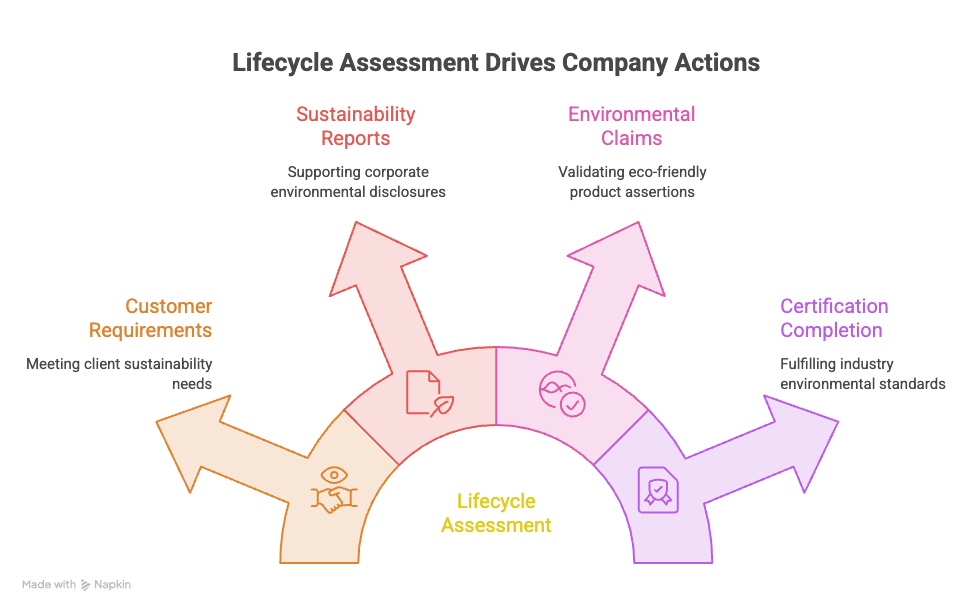
- Manufacturers are being asked to provide environmental data throughout the product lifecycle.
- Sales teams receive sustainability questionnaires from enterprise customers.
- Product teams evaluate materials based on both cost and environmental impact.
- Exporters prepare for regulations such as Digital Product Passports, EcoDesign requirements, and carbon reporting.
- Marketing teams need credible environmental claims backed by measurable data.
Instead of being an annual exercise, sustainability data is becoming part of everyday business decisions.
Naturally, companies are beginning to question whether traditional consulting models are designed for this new reality.
A Case Study: One Company, Two Different Approaches
Imagine a mid-sized packaging manufacturer. The company produces sustainable packaging for food and consumer brands. Over the next three years, they expect to:
- Launch 20 new SKUs
- Improve existing packaging designs
- Switch suppliers based on pricing and availability
- Respond to customer requests for environmental data
- Explore lower-carbon material alternatives
They have two options for conducting Lifecycle Assessments.
Option 1: Hire an LCA Consultant
The company engages a consultant for its first product. The process is familiar.
Data is collected from suppliers.
Manufacturing information is compiled.
The consultant builds the lifecycle model, validates assumptions, and delivers a comprehensive report.
The assessment is technically robust and provides valuable insights.
Everyone is satisfied.
Then the business evolves.
A new product is introduced.
One supplier changes.
Packaging weight is reduced.
A different adhesive is selected.
A customer requests updated carbon footprint numbers.
Each of these changes requires another engagement.
The company isn’t repeating work because the consultant lacks expertise.
They’re repeating work because every assessment is treated as a new project.
Option 2: Use an LCA Platform
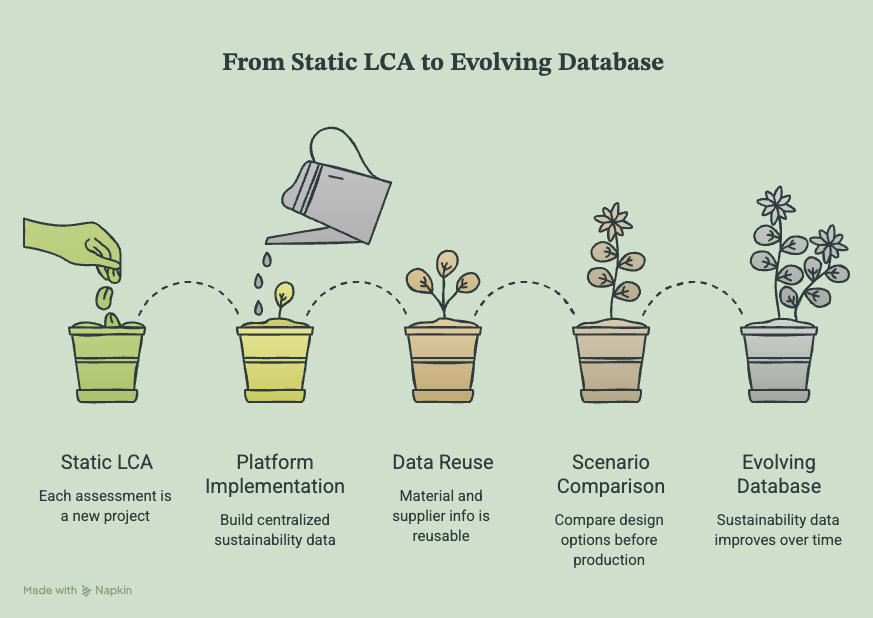
Instead of starting from scratch each time, the company builds its sustainability data within a centralized platform.
Material libraries are created once.
Supplier information becomes reusable.
Manufacturing processes are stored centrally.
When a new product is developed, much of the existing information already exists.
Teams can compare multiple design scenarios before production begins.
Updated assessments can be generated whenever suppliers or materials change.
Rather than producing a static report, the company develops an evolving sustainability database that improves with every product launched. The first implementation requires effort.Every assessment after that becomes significantly easier.
The Difference Isn’t Accuracy
One of the biggest misconceptions is that platforms replace consultants.
They don’t.
Both approaches are capable of producing scientifically rigorous Lifecycle Assessments.
The real difference lies somewhere else. It’s about how environmental intelligence is created, reused, and scaled across an organization.
Consultants optimize individual projects.Platforms optimize ongoing capability. As businesses expand their product portfolios, that distinction becomes increasingly important.
The Hidden Problem: LCA Becomes a Cost-Compounding Process
Most companies think about LCA as a cost per report. In reality, the cost grows alongside every change in the business.
Every new SKU requires assessment.
Every packaging redesign changes environmental impact.
Every supplier switch introduces new data.
Every customer request demands updated information.
Every regulation requires fresh documentation.
Under a consultant-led model, these activities frequently become separate projects.
Over time, the business isn’t just producing more products.
It’s creating more sustainability work.
And that’s where costs begin to compound. You’re not paying more because the assessments are becoming harder. You’re paying more because your business is becoming more dynamic.
This is why many organizations find themselves in an unexpected position. They value Lifecycle Assessment. They simply can’t afford to perform it as frequently as they’d like.
Instead of becoming part of product development, LCA becomes something reserved for high-priority customers or compliance deadlines.
Ironically, the very tool designed to support sustainable innovation starts slowing it down.
Understanding the Cost Curve
Think of LCA like accounting.
If a business hired an external accountant every time an invoice was generated, costs would quickly become unsustainable. Instead, companies invest in accounting systems that make financial management part of daily operations.
Lifecycle Assessment is following a similar path.
As sustainability becomes integrated into procurement, product design, exports, and customer engagement, businesses need systems that improve with every product they add, not processes that restart every time something changes.
That’s the fundamental shift driving the adoption of LCA platforms. They’re not simply replacing consultants. They’re changing the economics of sustainability itself.
LCA Platform vs. Consultant: A Side-by-Side Comparison
While both approaches can deliver high-quality Lifecycle Assessments, they solve different business problems.
| Criteria | LCA Consultant | LCA Platform |
| Best suited for | One-off studies, complex products, third-party verification | Ongoing assessments, product portfolios, continuous improvement |
| Cost model | Project-based | Subscription or platform-based |
| Time to complete | Weeks | Days or hours, depending on data readiness |
| Adding new SKUs | New engagement required | Built on existing product and supplier data |
| Scenario analysis | Additional consulting effort | Compare multiple design options within the platform |
| Data ownership | Often report-centric | Centralized, reusable, continuously updated |
| Scalability | Costs increase with every project | Marginal cost per additional product decreases over time |
The decision isn’t about choosing one over the other.
It’s about choosing the right operating model for your business.
When Does an LCA Consultant Make More Sense?
Consultants continue to play a critical role in sustainability.
They bring domain expertise that software alone cannot replace.
A consultant is often the right choice when you’re:
- Conducting your first-ever Lifecycle Assessment
- Preparing an Environmental Product Declaration (EPD)
- Seeking independent third-party verification
- Evaluating highly complex or bespoke products
- Developing long-term sustainability strategy
These projects benefit from expert interpretation and industry experience.
For many organizations, consultants provide the confidence needed to establish robust sustainability practices.
Why This Matters Even More for Indian Manufacturers
Most Lifecycle Assessment software available today was built for mature European and North American markets.
Indian manufacturers operate under very different conditions.
Supply chains are more fragmented.
Material sourcing changes frequently.
Supplier data isn’t always standardized.
Many businesses rely on regional vendors with limited environmental documentation.
Global emission databases often don’t accurately reflect Indian manufacturing processes, electricity grids, logistics networks, or locally sourced materials.
As a result, companies spend significant time adapting global tools to fit Indian realities.
The challenge isn’t just calculating environmental impact.
It’s finding data that represents the products being manufactured.
What to Look for When Choosing an LCA Platform
At Untrash, we believe Indian businesses shouldn’t have to force-fit global sustainability tools into local manufacturing realities.
That’s why we built Untrash as an India-first Lifecycle Assessment and Circularity intelligence platform.
Rather than simply digitizing the consulting process, we’re building the data infrastructure that Indian manufacturers actually need.
That includes:
- India-specific emission factors and datasets
- Material intelligence tailored to Indian supply chains
- Industry-specific workflows for packaging, textiles, manufacturing, consumer goods, and exports
- Supplier intelligence that grows over time
- Product-level impact tracking across entire portfolios
- Built-in readiness for emerging global regulations, customer disclosures, and sustainability reporting
As companies add more products, suppliers, and materials, the platform becomes richer. Instead of recreating assessments, businesses continuously build a reusable sustainability knowledge base. This is especially important for Indian manufacturers serving global markets. International buyers increasingly expect credible environmental data, but they also expect it quickly.
Businesses that can generate trusted product-level insights in days instead of weeks will have a significant competitive advantage.
The Bottom Line
Lifecycle Assessment is no longer a one-time sustainability exercise.
It’s becoming a core business capability that influences product development, procurement, customer relationships, exports, and regulatory readiness.
Consultants will continue to play an important role, especially where expertise, validation, and strategic guidance are required. But for businesses managing growing product portfolios, the bigger opportunity lies in building systems that make sustainability data reusable, accessible, and actionable.
That’s where platforms are changing the economics of LCA. And that’s the vision behind Untrash.
We’re building an India-first sustainability intelligence platform that helps manufacturers measure, improve, and communicate environmental impact without sustainability costs growing in proportion to their business. Because as Indian companies compete globally, sustainability shouldn’t become another operational bottleneck.
It should become a competitive advantage.
Frequently Asked Questions
What is the difference between an LCA platform and an LCA consultant?
An LCA consultant provides expert-led Lifecycle Assessment services for individual products or projects. An LCA platform enables businesses to conduct, update, and manage LCAs across multiple products using centralized data and standardized workflows.
When should a company invest in an LCA platform?
If your business manages multiple products, frequently updates designs or suppliers, or regularly responds to customer sustainability requests, an LCA platform offers greater long-term efficiency and lower cost per assessment.
How much does a Lifecycle Assessment cost?
The cost varies depending on product complexity and methodology. Consultant-led LCAs are typically priced per project, while software platforms usually follow a subscription model, making them more cost-effective for companies with multiple products.
What industries benefit most from LCA software?
Lifecycle Assessment platforms are widely used across:
- Packaging
- Manufacturing
- Consumer Goods
- FMCG
- Chemicals
- Textiles
- Electronics
- Construction Materials
- Automotive Components
How do I choose the right LCA platform?
Evaluate platforms based on:
- Data quality
- Localized emission databases
- Regulatory support
- Product scalability
- Collaboration features
- Scenario modelling
- Ease of implementation
Why are India-specific emission factors important?
Using localized emission factors improves the accuracy of assessments by reflecting India’s electricity mix, transportation systems, manufacturing processes, and material supply chains instead of relying solely on European or global averages.