What DPP Software Needs to Support in Fashion

What DPP Software Needs to Support in Fashion
If you’re an Indian exporter today, your biggest competitor is no longer just another factory in Vietnam or Bangladesh.
It’s the regulation.
The European Union is steadily rewriting the rules of trade through sustainability-first policies. And unlike earlier voluntary frameworks, these are becoming hard market entry conditions. At the center of this shift is the Digital Product Passport (DPP), introduced under the Ecodesign for Sustainable Products Regulation (ESPR). This isn’t just another compliance checkbox. It’s a structural change in how products are designed, tracked, and sold in the EU.
Why this matters for Indian exporters
The EU is one of India’s largest export markets across sectors like textiles, automotive components, electronics, and packaging. And multiple signals now point in one direction:
- The ongoing India–EU Free Trade Agreement is expected to deepen trade access
- Policies like Carbon Border Adjustment Mechanism (CBAM) are already pricing carbon into exports
- ESPR + DPP will extend this from carbon to full product lifecycle transparency
In simple terms👉 No data = No market access.
The EU is moving from “tell us you’re sustainable” to “prove it, product by product, in a standardized digital format.”
What is the Digital Product Passport (DPP), really?
Well, ofcourse it is a passport for your products but think of DPP as a living data layer attached to every product.
It will require exporters to share structured information such as: Material composition, Carbon footprint, Supply chain traceability, Repairability and Recyclability, Compliance with environmental standards.
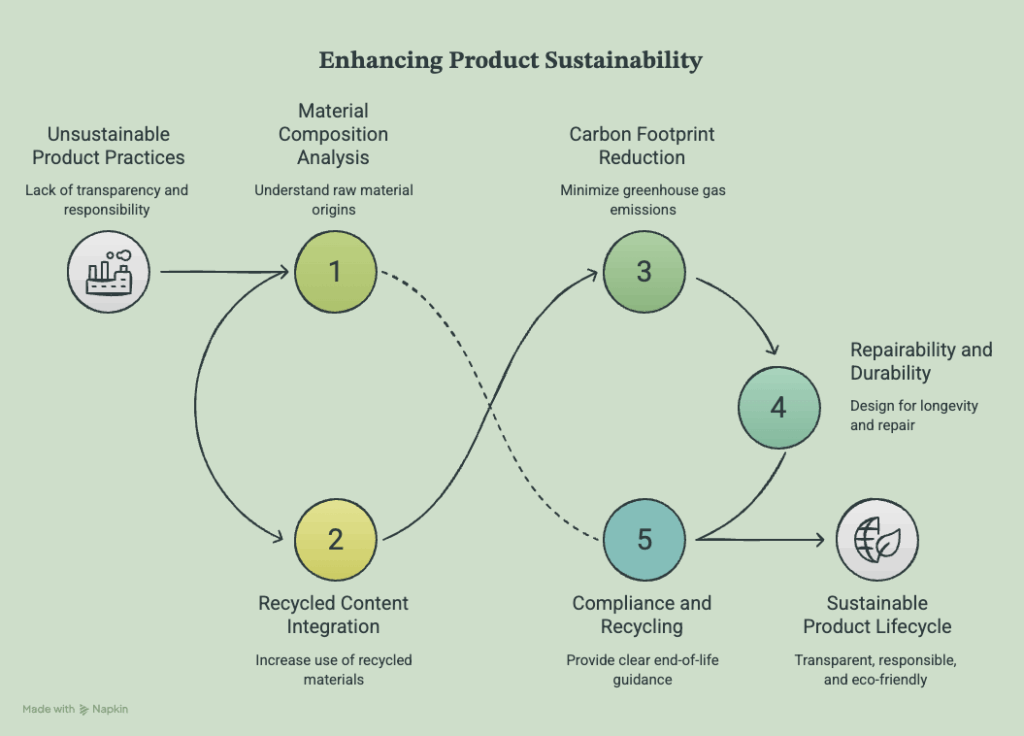
And this data must be:
- Digitally accessible (QR / RFID / cloud-linked)
- Standardized across the EU
- Verifiable across the value chain
This is product-level transparency at scale. A great initiative to move from linear economy to a much needed transition towards the Circular economy. Historically, Indian exporters optimized for: Cost, Scale, Speed. Now, a fourth lever is being enforced externally:
👉 Data-backed sustainability
And this is where it gets interesting:
- EU buyers will increasingly prefer suppliers who are DPP-ready
- Large brands will push requirements downstream to Indian MSMEs
- Early adopters will gain preferred supplier status, not just compliance clearance
So this is not just risk. It’s positioning and moulding yourself to the new market access and new norm for circular economy.
But here’s the reality: How are companies handling Digital Product Passport today?
Before DPP becomes mandatory, most Indian companies are still operating in fragmented, manual, or semi-digital ways.
1. Spreadsheet-led sustainability (the default chaos)
- Data collected in Excel across teams
- Supplier data via emails and PDFs
- Version control issues
- Impact numbers are mostly a guess
Result:
👉 High effort, low reliability, zero scalability
2. Certification-driven approach
- Relying on eco-labels and certifications
- Periodic audits instead of continuous data
Good for Signaling credibility
Not enough for Real-time, product-level traceability required by DPP
3. Global tools
- Used to calculate carbon footprint and environmental impact
- Often consultant-led or SaaS-based
Limitations:
- Global tools lacks Indian context
- Static outputs vs dynamic product passports
- Consultant-led projects often drags for months, feels like manual chaos
The companies that wait for the final compliance deadline may find themselves trying to build years’ worth of product and supply-chain data in a matter of months. The smarter approach is to start with the data you already have.
Understand what information exists. Identify what is missing. Bring supplier data into the picture. Start measuring product-level environmental impact. And, most importantly, build a system where this information can actually be used instead of living forever in spreadsheets and PDFs.
Where Untrash fits in
At Untrash, we are building the sustainability and product intelligence layer that helps businesses get ready for this shift.
Untrash brings together product-level LCA, carbon footprinting, supplier data, traceability and compliance information so businesses can move from fragmented sustainability data to structured, usable product intelligence.
The goal isn’t simply to generate a Digital Product Passport.
It is to help businesses build the data and systems that make that passport possible.