Why Indian MSMEs Need Data, Sustainability, and Compliance to Win More Business

For decades, India’s MSMEs have been told that growth comes from one thing: producing more.
Increase capacity. Reduce costs. Improve efficiency. Deliver faster.
Those priorities built one of the world’s largest manufacturing ecosystems. But today, a different shift is underway. One that is far less visible than a new factory or production line.
The question facing MSMEs is no longer just: Can you manufacture?
It’s becoming: Can you prove you’re the right supplier to manufacture?
This single shift is about to change everything.
Today’s buyers, regulators, lenders, and even government programmes increasingly expect businesses to demonstrate credibility through documentation, compliance, sustainability, and operational maturity, not just production capability. When you look closely at India’s latest MSME initiatives, a clear pattern emerges.
The future competitive advantage isn’t being built only on the factory floor.It’s being built through data.
The Government’s Priorities Have Changed
Most government support programmes were historically designed to solve production challenges.
Machines, Infrastructure, Capital,Technology. But recent initiatives reveal a broader ambition.
Schemes like RAMP (Raising and Accelerating MSME Performance), ZED (Zero Defect Zero Effect), the Procurement and Marketing Support (PMS) Scheme, digital compliance initiatives, and market access programmes all focus on strengthening capabilities that exist beyond manufacturing.
Look at where investments are being directed:
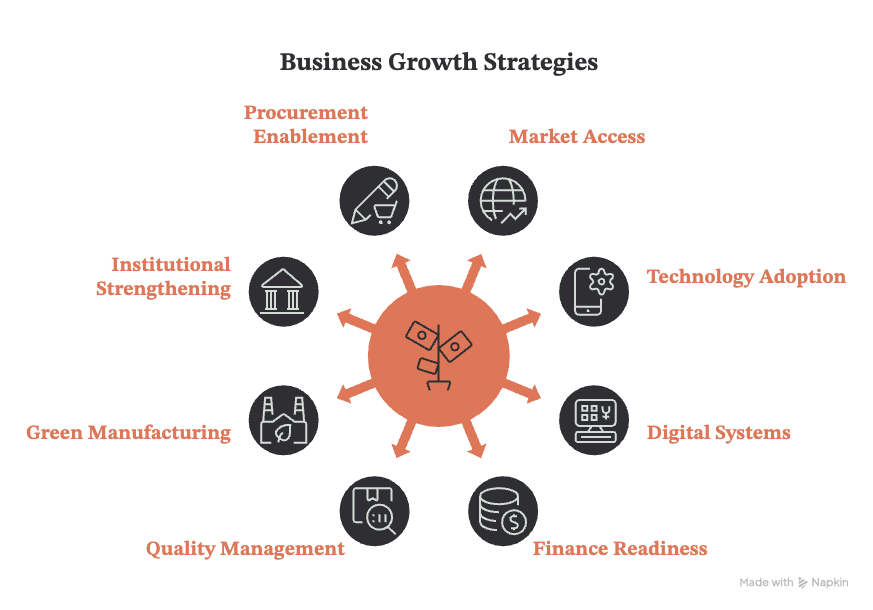
Notice what’s missing?
Very little of this directly increases production capacity. Instead, these programmes improve an MSME’s ability to compete. That’s an important distinction. The government appears to recognize that Indian manufacturers don’t struggle simply because they can’t produce.
Many struggle because they can’t consistently access larger buyers, qualify for procurement programmes, demonstrate compliance, or scale into global markets.
In other words, production gets you into the market. Capability gets you considered!
Manufacturing Is No Longer Enough
Imagine two suppliers manufacturing the exact same product.
Both offer competitive pricing. Both deliver acceptable quality and a similar production capacity. But only one of the supplier provides:
- Complete certifications
- Digital documentation
- Product traceability records
- Sustainability information
- Standardized product data
- Procurement-ready documentation
The other doesn’t.
Which supplier is easier for a global buyer to onboard? The answer is increasingly obvious. Modern procurement teams aren’t simply evaluating products. They’re evaluating risk.
Every missing certificate creates friction. Every unanswered sustainability question creates uncertainty.Every document that has to be chased creates work. And every unclear process makes onboarding harder.
Good information doesn’t just make a supplier look organised. It makes them easier to trust! And in procurement, lower perceived risk can be a very powerful advantage. The supplier with better information often becomes the supplier with lower perceived risk. And lower risk frequently wins contracts.
RAMP Isn’t Just a Support Programme. It’s a Capability Programme.
At first glance, RAMP can look like another government support programme. Look a little closer, though, and there’s a broader story. Its priorities include market access, technology adoption, financial readiness, institutional strengthening, reducing payment delays and supporting green enterprises.
These aren’t simply factory upgrades.They’re business capability upgrades. They can help make an MSME easier to discover, easier to finance, easier to support and, importantly, easier to do business with.
That matters because growth isn’t only about having the ability to fulfil a larger order. It’s about being able to win the order.
Sustainability Is Quietly Becoming a Procurement Requirement
For many MSMEs, sustainability has historically sat somewhere on the sidelines. Maybe it’s a CSR initiative. Maybe it’s a sustainability page on the website. Maybe it’s something discussed when a large customer asks about it. But in today’s conscious era, that is changing.
Large companies, multinational buyers and global supply chains are increasingly asking suppliers for information about environmental performance, responsible sourcing and emissions. The questions can sound simple:
What is your carbon footprint?
Where do your materials come from?
Can you provide environmental data for this product?
How do you manage waste?
Can you support our sustainability reporting?
These questions aren’t coming only from regulators. They’re coming from procurement teams.
Environmental performance is gradually moving from the marketing department into supplier evaluation checklists. And once something becomes part of procurement, it becomes part of business strategy.
ZED Shows Where Supplier Expectations Are Heading
The Zero Defect Zero Effect (ZED) programme offers one of the clearest signals of this transition. The
“Zero Defect” principle is familiar. Quality has always mattered. “Zero Effect” adds another dimension: manufacturing shouldn’t create unnecessary environmental impact.
Ten years ago, buyers asked for quality certifications. Today, they increasingly ask for quality certifications alongside sustainability information. Tomorrow, supplier onboarding may routinely require:
- Carbon footprint information
- Product traceability
- Responsible sourcing documentation
- Lifecycle impact data
- Circularity metrics
- Resource efficiency evidence
The direction is becoming increasingly clear. The definition of a “good supplier” is expanding!
Procurement Is Becoming the New Growth Engine
Most businesses think growth comes from selling more. Government programmes increasingly suggest that growth may instead come from being selected more often. The Procurement and Marketing Support Scheme reflects this shift.
Its emphasis isn’t on manufacturing capacity. Instead, it focuses on helping MSMEs become procurement-ready through initiatives like:
- Trade fairs
- Vendor development programmes
- Packaging modernization
- Barcoding
- Digital commerce
- Market access
Each initiative reduces friction between suppliers and buyers.
A business with standardized packaging, digital product information, certifications, and organized documentation enters more procurement conversations. One without these capabilities often remains confined to local markets.
The manufacturers that thrive over the next decade may not simply be those with the largest factories.
They may be the ones that are easiest to buy from.
The Real Competitive Advantage Is Trust
Every government programme seems to converge on one invisible objective.Trust.
Banks need trust before approving credit.Buyers need trust before onboarding suppliers.
Export markets need trust before accepting products. Government agencies need trust before awarding incentives. Historically, trust was relationship-driven. Today, it’s becoming evidence-driven. Evidence comes in many forms: Certifications, Assessments, Documentation, Digital records, Performance data, Compliance reports, Sustainability disclosures.
Businesses that can produce reliable operational information build confidence faster than businesses that cannot. In an increasingly digital economy, trust is becoming measurable.
India Is Quietly Building a New MSME Operating System
Viewed individually, programmes like RAMP, ZED, PMS, NSIC support, digital governance initiatives, and dispute resolution mechanisms appear unrelated.
Viewed together, they resemble something much larger.
A coordinated framework for preparing MSMEs to compete in increasingly structured supply chains.
Each programme strengthens a different layer:
| Programme Focus | What It Builds |
| Registration | Business identity |
| Financial support | Capital access |
| Market access | Buyer visibility |
| ZED | Operational maturity |
| Digital systems | Governance and transparency |
| Green initiatives | Long-term competitiveness |
Together, they point toward a common destination. An MSME ecosystem that is:
- Digitally enabled
- Standardized
- Quality focused
- Environmentally responsible
- Procurement ready
This isn’t simply about compliance. It’s about positioning Indian manufacturers for participation in global value chains.
The Game Has Changed
Factories may look the same. Machines may still run the same production lines. But the criteria for winning are changing. The next generation of successful MSMEs won’t compete only on what they manufacture.
They’ll compete on how transparently they operate, how easily they can be trusted, and how seamlessly they fit into modern procurement ecosystems. India’s latest MSME initiatives are preparing businesses for that future. The real question is no longer whether manufacturers can produce. It’s whether they’re ready for a marketplace where trust, transparency, and data become just as important as the products leaving the factory floor.